Ingredients

Method
For the meringue:
- Preheat the oven to 284º F (140° C) (this will not be the final temperature). Using a pencil, mark a circumference of approximately 20 cm on a piece of parchment paper and place it on a large baking sheet. A large plate or cake pan can be used as a reference to mark the circle.
- In a large bowl add the egg whites and beat with an electric mixer for 2 minutes until slightly stiff peaks form.
- Continue beating and carefully and gradually add the sugar. It can be added by spoonfuls a little at a time. Beat for 6 more minutes until very stiff peaks form and the meringue is smooth and glossy. To check to see if the meringue is ready, take a little between your fingers and rub it, there should be no grains of sugar.
- Add in the white vinegar, cornstarch and vanilla extract. Beat for a few seconds just until they are incorporated into the meringue.
- To form the pavlova, using a rubber spatula pour all the meringue mixture on the baking paper with the circle drawn. Spread the meringue carefully until it has a uniform height of 2.30-3.10 inches (6-8 cm).
- Use an offset spatula or a dull knife to create ridges all around the pavlova, going from the bottom up. Then smooth out the edges to get rid of any very pronounced edges in the meringue (which can easily turn too brown and burn). At this point, the pavlova will have a wide base and a slightly narrower top.
- With the same offset spatula, create a very shallow hole space in the center of the pavlova, which will make it have more even sides as well. The center of the pavlova should not be hollow, but just a little sunken.
- Carefully transfer the pavlova to the oven and quickly reduce the oven temperature to 230º F (110° C). Bake for 80-90 minutes and do not open the oven door at all during this time. The pavlova is ready when it forms a dry crust.
- Turn off the oven and let the pavlova cool inside the oven, without opening the oven door, overnight or a minimum of 4 hours, until completely cooled.
For the cream and topping:
- In a large bowl, add the whipping cream with the powdered sugar and vanilla extract. Beat with an electric mixer or hand whisk for 2-3 minutes until slightly stiff peaks form.
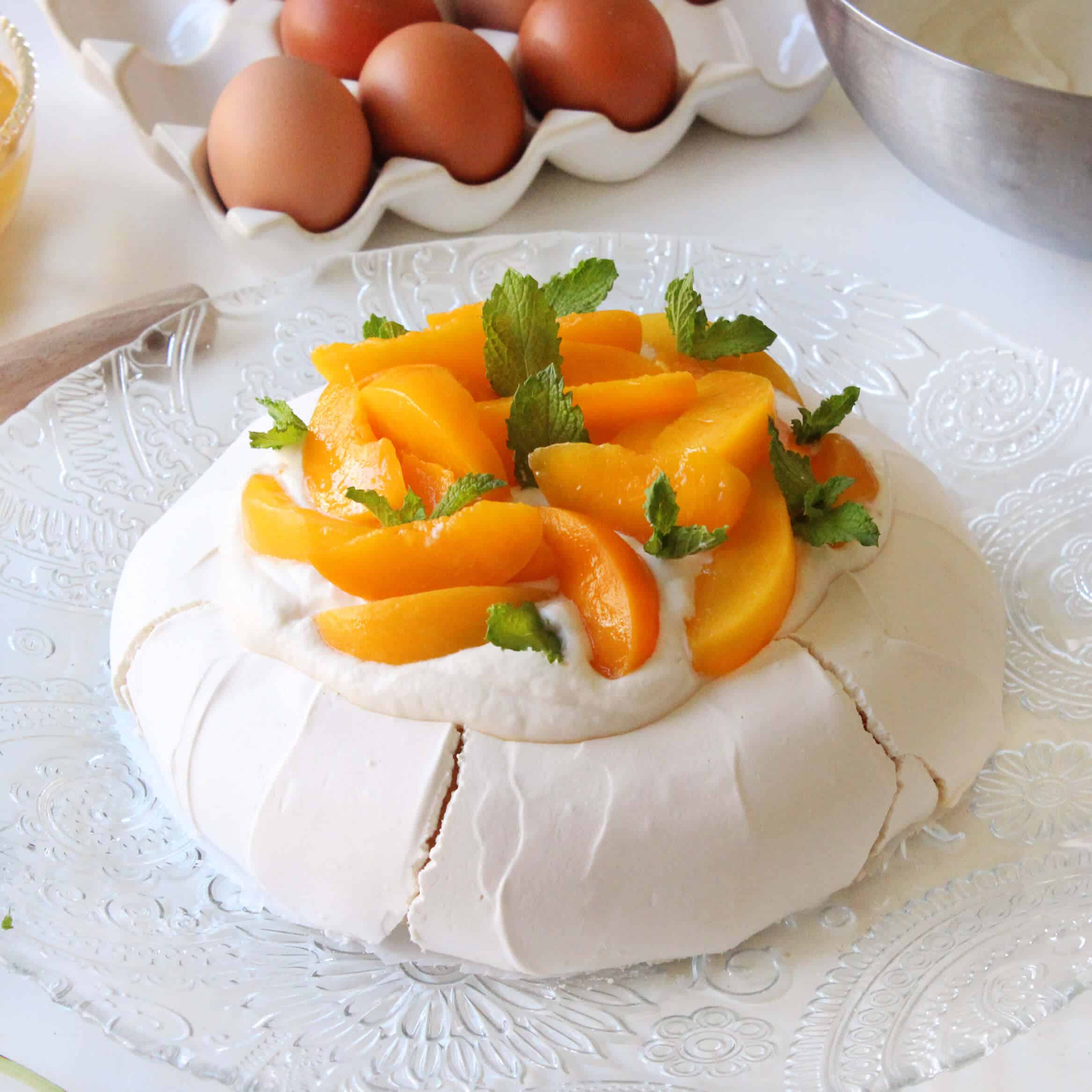
- To assemble the pavlova, transfer to a large serving platter. If necessary use a dull knife to loosen the edges of the pavlova from the baking paper. Using a spoon, carefully crack the surface of the pavlova so that its crust sits on top of the inside of the pavlova. The inside will resemble the texture of marshmallow and it is normal for it to deflate a bit. This step will prevent the pavlova from collapsing when you put the whipped cream on top.
- Add the whipped cream on top of the pavlova and carefully spread it with a spoon or rubber spatula. Garnish with the peach slices on top and mint leaves if desired, until they cover most of the cream.
- If the pavlova is not to be served immediately, transfer to an airtight container and store in a cool, dry place. It can also be left in the oven but should not be stored in the refrigerator or freezer.